


Table of Contents
Choosing the best eSIM for Australia depends on your itinerary, data usage, and the mobile networks available where you plan to travel. A city break in Sydney or Melbourne has different connectivity needs from a road trip through regional Australia or the outback.
A prepaid travel eSIM can help you get connected without buying a physical SIM card after landing. Before choosing a plan, compare its data allowance, validity period, supported Australian networks, hotspot policy, and total price.
Quick answer: For a one- to three-week holiday, estimate your daily data usage and choose a plan that covers your entire trip. If you will travel beyond major cities, check the underlying network carefully: coverage can vary considerably between urban areas and remote destinations.
Compare the Australia eSIM plans available from Atlas eSIM to find an option that suits your trip.
How we make money: Atlas eSIM sells the plans linked in this guide, and we earn money if you buy one. Alternatives are covered with the same criteria. How we research and compare
Get your Australia eSIM
Stay connected throughout Australia — instant activation, no roaming bill.
How We Evaluation & Selected the Best eSIM Plans for Australia
To help you find the right mobile data plan for Down Under, we evaluate travel eSIMs using objective, practical criteria:
-
Network Quality & Partner Carriers: We verify which tier-1 Australian networks—Telstra, Optus, or TPG/Vodafone—power each eSIM profile.
-
Geographic Coverage: Coverage details are cross-referenced with official carrier maps and data from Australian telecommunications authorities (such as the ACMA).
-
Value & Data Flexibility: We assess pricing, daily vs. total data caps, and validity windows to ensure cost-efficiency for short visits, road trips, or long stays.
-
Traveler-Friendly Features: Tethering/hotspot support, ease of QR-code setup, app management, and top-up options are critical factors in our ranking.
How We Evaluation & Selected the Best eSIM Plans for Australia
This guide is designed to clarify the differences between travel eSIMs, local prepaid Australian SIMs, and international roaming:
-
Travel eSIMs: Offer instant setup before departure and fixed prepaid costs, eliminating unexpected roaming fees.
-
Local Physical SIMs: May include local voice minutes or higher data caps, but often require ID verification (passport checks) upon landing.
-
International Roaming: Convenient, but often carries expensive daily pay-as-you-go rates from domestic home carriers.
-
Methodology Note & Transparency
Mobile plan pricing, coverage footprints, and terms change frequently—always verify active offers before purchasing. Where Atlas eSIM internal data informs a recommendation, analysis is based on verified activation logs and clear usage metrics. We do not claim independent physical field tests unless explicitly noted in the specific plan evaluation.
Last checked: September 2026.
What actually matters in an eSIM Australia comparison
Most Australia eSIM comparison articles rank plans by price per gigabyte and stop there. That’s a poor proxy for whether the plan will work for you. Here are the criteria that genuinely change the outcome.
Coverage across a very large country
Any Australia eSIM comparison starts with where people live. The population clusters along the east and south coasts, and so does network coverage. In Sydney, Melbourne, Brisbane, Perth and Adelaide you can expect solid 4G and widespread 5G on all three major networks — Telstra, Optus and Vodafone/TPG.
Leave the cities and the eSIM Australia plan you chose starts to matter. On outback highways, parts of Tasmania and stretches of the Great Ocean Road, coverage thins to a single network or nothing at all. If your itinerary is coastal and urban, almost any reputable travel eSIM will do. If you’re driving inland, choose a provider that connects to a network with the broadest regional footprint, and download offline maps regardless.
Your realistic daily data use
This is where a cheap eSIM Australia plan turns into an expensive one. Navigation, messaging, email and a bit of social scrolling typically runs 300–700 MB a day. Add streaming, video calls or tethering a laptop and you can pass 1.5–2 GB daily without trying.
Rather than buying the largest eSIM Australia plan available, estimate honestly and pick one tier above your estimate. Hotel and café Wi-Fi is common in Australian cities and will absorb a meaningful share of your usage.
Validity window, not just volume
A 10 GB eSIM Australia plan valid for seven days is useless on a three-week trip. Match the validity to your itinerary plus a buffer of a day or two for delayed flights and the long haul home.
Hotspot, phone numbers and what you give up
An Australia eSIM is almost always data-only. That means no Australian mobile number, so you can’t receive SMS one-time codes on the local line or dial 000 from it — though your phone can always call emergency services on any available network.
A data-only Australia eSIM is fine for the vast majority of travellers, because messaging and calls now happen over apps. Keep your home SIM active in the second slot for bank SMS codes, and your WhatsApp number stays exactly as it is when you switch data to the eSIM.
Device compatibility and the 3G shutdown
Most flagship phones released from 2018 onward support eSIM, but there are exceptions — notably some models sold in mainland China and certain carrier-locked handsets. Check your specific model before buying; our rundown of which handsets handle eSIM lists the main families.
One catch specific to every Australia eSIM: the country’s 3G networks were switched off during 2024, a transition overseen by the Australian Communications and Media Authority. If your phone is older or was bought overseas without proper VoLTE support, it may struggle even where coverage is good. A 4G/5G-capable handset from the last few years avoids the problem entirely.
Get your Australia eSIM
Stay connected throughout Australia — instant activation, no roaming bill.
Australia eSIM comparison: travel plan, prepaid SIM or roaming
Here is how the three realistic alternatives to a top eSIM Australia plan stack up for a visitor. No prices are quoted because they shift constantly and vary by carrier — check current rates before you commit.
| Travel eSIM | Australian prepaid SIM | Home carrier roaming | |
|---|---|---|---|
| Setup time | Minutes, before you fly | 20–60 min at an airport or store, passport needed | Instant, if enabled |
| Works on landing | Yes, activates on arrival | No, after purchase | Yes |
| Local phone number | Usually not | Yes | Keeps your home number |
| Typical cost for a 2-week trip | Low to moderate | Low, especially for large data | Highest, unless on a roaming-inclusive plan |
| Flexibility | Top up or add a new plan instantly | Tied to one carrier, in-store top-ups | None |
| Best for | Most visitors, 3 days to 6 weeks | Stays over a month, heavy data users | Very short trips on an inclusive plan |
The honest summary: a cheap eSIM Australia plan wins on convenience and on cost against roaming, while a local prepaid SIM can beat it on raw gigabytes if you’re staying long enough to justify the queue at the airport counter. If you want the arithmetic on the roaming side, we’ve broken it down in our eSIM versus roaming cost comparison.

The five specifications that decide an eSIM Australia plan
Ignore the marketing and check these five things. They are the whole comparison.
1. Which network it rides on. This is the single most important specification in Australia and the one most plans are vaguest about. Telstra’s footprint is substantially larger than Optus’s, which is substantially larger than Vodafone’s, and the gap widens the further you get from the coast. A plan riding on Vodafone is excellent value for Sydney and Melbourne and close to useless on the Stuart Highway. If the seller will not tell you which network you connect to, that is itself an answer. For reference, Boost Mobile is the one reseller with access to Telstra’s full retail network rather than a reduced version of it.
2. Whether validity starts at purchase or at activation. Australia is a long flight from almost everywhere, and a plan whose clock starts when you pay rather than when the profile first connects can burn two days before you land. Buy only plans that activate on first network registration, and install the profile at home regardless.
3. Whether you can top up without a new profile. Distances in Australia mean you often discover you are short of data somewhere with poor signal and no time. A plan that lets you add a bundle in-app to the existing line is materially better than one that makes you install a second profile — which needs a working connection to download, exactly when you do not have one.
4. Whether tethering is permitted. The common Australian pattern is a campervan or a hire car with two to four people sharing one connection. Several plans restrict or meter hotspot use separately, and a few forbid it outright. If you are sharing, this specification matters more than the size of the allowance.
5. Whether it is Australia-only or trans-Tasman. A very large proportion of visitors add New Zealand to the same trip. An Australia-only profile stops dead at the border. Regional plans covering both cost less than two country plans and remove the problem, so decide this before you buy rather than after.
What does not matter as much as you think. Speed. All three Australian networks deliver more than any traveller needs where they have coverage, and a cheap eSIM Australia plan is not slower than an expensive one in any way you will notice. The variable is whether there is a tower, not how fast it is.
How much data to buy for your type of trip
Two weeks of sightseeing in Sydney and Melbourne
Maps, ride-hailing, restaurant bookings, photos to the family group chat. Budget 500 MB–1 GB a day, which lands you around 8–14 GB. Accommodation Wi-Fi will cover evening streaming.
A three-week road trip or east coast run
Longer driving days push a cheap eSIM Australia plan harder: more navigation, and regional gaps mean you’ll reload pages more often. Aim for 15–20 GB, and prioritise a plan on a network with strong regional reach over one with a slightly better per-gigabyte rate.
Remote work from an Australian base
If you’re tethering a laptop for calls and file syncs, assume 2–3 GB on working days. A month of that is 40 GB or more — at that point, either buy a large eSIM plan or consider a local prepaid SIM. Our guide for remote workers on the road covers the backup-connection habits worth adopting.
Multi-country Oceania itineraries
Adding New Zealand, Fiji or Papua New Guinea? A regional plan that covers several countries on one profile is tidier than buying separately. See the Oceania multi-country option and, if New Zealand is a main stop, the dedicated New Zealand connectivity guide.
Before you finish any Australia eSIM comparison, note that coverage maps are published publicly by each network and searchable by address. If you have a specific remote booking — a farm stay, a national park lodge — check the address against the network map before you pick a provider. It takes two minutes and saves a signal-free weekend.
Choose a Australia eSIM that matches the trip you are planning.
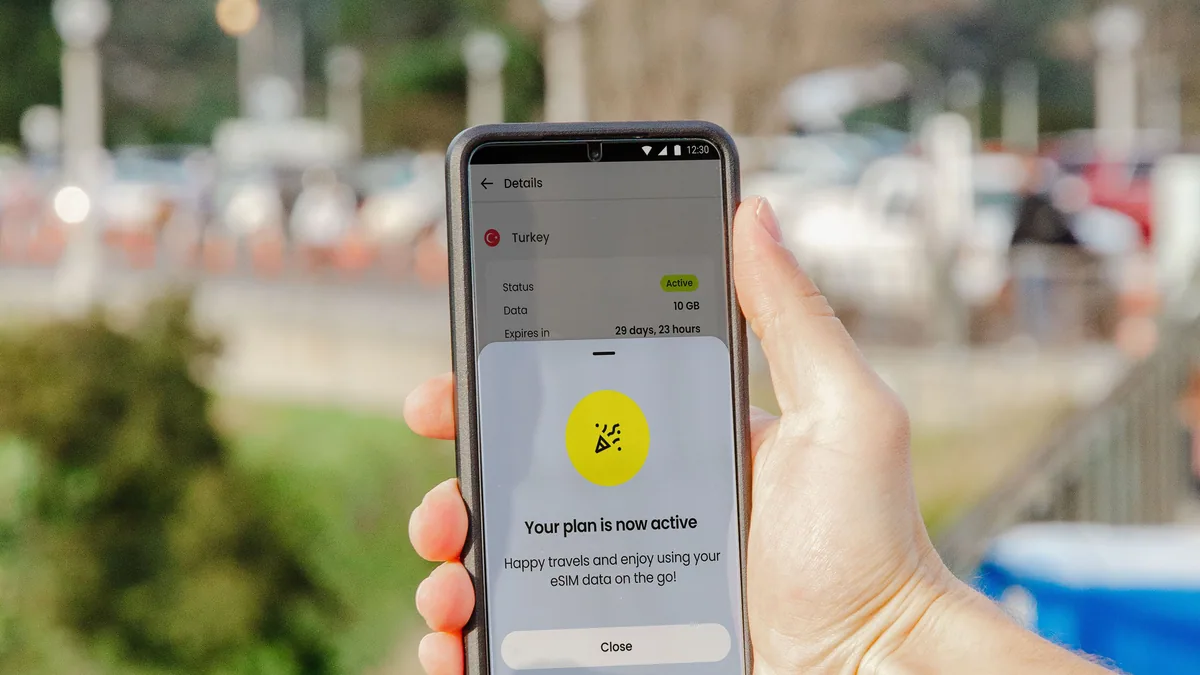
Validity, tethering and top-ups matter more than price per gigabyte.
Get your Australia eSIM
Stay connected throughout Australia — instant activation, no roaming bill.
Five ways a cheap eSIM Australia plan costs you more
Cheap is fine. Cheap and badly specified is what produces the complaints. These are the five failure modes worth checking for before you buy.
The metro-only network. The cheapest Australia eSIM plans are cheap because they ride on the network with the smallest rural footprint. For a Sydney city break that is a genuine bargain. For the Great Ocean Road, the Queensland coast or anything inland it means long stretches with nothing while the person next to you on Telstra has four bars.
The validity that started last Tuesday. A seven-day plan bought a week before departure and activated on purchase leaves you with nothing on arrival. This is the most common complaint in the category and it is entirely avoidable by reading one line of the terms.
The unlimited plan that is not. Daily unlimited products throttle after a threshold, and the threshold is often lower than a day of navigation across long distances uses. Read the fair-use clause, and treat any plan that will not state the threshold numerically as one that does not want you to know it.
The tethering ban you find out about in a campervan. Discovering that hotspot use is blocked after you have driven four hours from Cairns is a bad afternoon. If a plan does not explicitly permit tethering, assume it does not.
The expiry that eats what you paid for. Unused data almost never rolls over. Buying a large bundle for a two-week trip and using half of it is not thrift, it is a donation. In Australia especially, where consumption varies enormously between a city week and a driving fortnight, buying smaller and topping up beats buying big and hoping.
The device you should have checked. Australia retired 3G entirely, and some handsets bought overseas lost the ability to place emergency calls on the remaining networks. Separately, weak 700 MHz support means noticeably worse regional coverage on exactly the same plan. Neither is the seller’s fault and neither is fixable once you have landed.
When the best eSIM Australia plan is no eSIM at all
Recommending a top eSIM Australia plan for every situation would be dishonest. Skip it if:
- You’re transiting. A six-hour layover in Sydney with airport Wi-Fi does not need a paid data plan.
- Your phone doesn’t support eSIM. A physical local SIM or a pocket Wi-Fi device is the answer. We compare the eSIM and pocket Wi-Fi trade-offs if you’re travelling as a group.
- You’re staying three months or more. An Australian prepaid SIM with a local number and large recurring data allowance will almost certainly cost less, and you’ll want a local number for deliveries, banks and rentals.
- Your home plan already includes Australia. Some European and North American carriers bundle roaming in Australia at no extra charge. Read your plan’s fine print before buying anything.
Pros
- Installed and paid for before departure — no airport queue, no passport paperwork
- Keeps your home number active for SMS codes
- Easy to top up or replace mid-trip from your phone
- No physical SIM to lose or swap
Cons
- Usually no Australian phone number
- Not viable on older or eSIM-incompatible handsets
- Per-gigabyte cost is rarely as low as a long-term local prepaid plan
- Requires a Wi-Fi connection at the moment of installation
Setting it up before you fly
- Confirm your handset supports eSIM and is carrier-unlocked. Check the manufacturer’s support pages, or see the step-by-step installation walkthrough.
- Buy your plan while you’re still at home, on Wi-Fi. You’ll receive a QR (Quick Response) code or an activation link.
- Install the profile: on iPhone, Settings → Mobile Service → Add eSIM; on most Android handsets, Settings → Network & internet → SIMs → Add eSIM.
- Label the line something obvious — “Australia” — so you don’t confuse it with your home SIM.
- Leave the eSIM switched off until you land, then enable it and turn data roaming on for that line only. This step trips up more travellers than any other.
- If scanning fails at the airport, the fix is usually a manual entry of the activation details. Our QR code troubleshooting notes cover the common causes.
Atlas eSIM plans install this way and activate the moment they detect an Australian network, so you can land at Sydney or Melbourne and have maps running before you reach baggage claim. For broader trip planning — seasons, transport, regional connectivity — our practical guide to travelling in Australia goes deeper.
For networks, coverage gaps and how much data you need, read our Australia eSIM travel guide.
Top eSIM Australia plans: frequently asked questions
Will my eSIM work the moment I land in Sydney?
Yes, provided you installed the profile before flying and enable the line plus data roaming after landing. Activation usually takes under two minutes once the phone finds an Australian network.
Can I use an eSIM to tether my laptop in Australia?
Most travel eSIMs allow personal hotspot, but confirm before buying as a few restrict it. Tethering consumes data quickly — assume a working day of laptop use costs 2–3 GB.
Do I need an Australian phone number as a tourist?
Rarely. Bookings, ride-hailing and messaging all work over data and your existing number, though a local number is genuinely useful if you’re staying for months or renting property.
Is a cheap eSIM Australia plan slower than an expensive one?
Not inherently. Speed depends on the underlying network and local congestion, not the price you paid — though some very low-cost plans throttle speeds after a set threshold, so read the fair-use terms.
What if I’m visiting New Zealand on the same trip?
A multi-country Oceania plan keeps one profile running across both, which is simpler than juggling two. If Australia is 90% of the trip, a country plan plus a short top-up is often cheaper.
For background on how eSIM technology is standardised worldwide, the GSMA maintains the specification that every compliant device and provider follows.
Compare Australia eSIM plans before you pack.
Get your Australia eSIM
Stay connected throughout Australia — instant activation, no roaming bill.
Which network should the best eSIM Australia plan use?
Telstra for anything outside the capital cities and the immediate coast; its rural build-out is far larger than the other two. Optus is a reasonable second along the east coast. Vodafone is a metro network and should be bought as one. This single specification matters more than price, allowance or brand.
How much data should I buy for an Australian trip?
Eight to twelve gigabytes covers most two-week itineraries with daily navigation. A city-only week runs three to five. A month of remote work needs its own budget. Buy at the lower end of your estimate and top up: unused data expires, and the top-up is usually cheaper than the regret.
Should I buy one long plan or several short ones?
One plan covering the whole trip, provided its validity starts on activation rather than purchase. Stacking short plans means re-installing profiles on the road, which needs a working connection at exactly the moment you have run out of one. The exception is a trip whose shape you genuinely cannot predict: there, buy a modest plan that supports in-app top-ups and extend it as you go. That combination — moderate bundle plus easy top-up — is the most forgiving structure for an Australian itinerary, because consumption varies so much between a city week and a driving fortnight.
Which eSIM Australia plan makes sense
Short city break, up to a week. A 3–5 GB plan is plenty if you’re staying in Sydney or Melbourne with hotel Wi-Fi in the evenings. Don’t overbuy — you can top up in seconds if you run short.
Standard two- to three-week holiday. 10–20 GB with validity covering your full itinerary plus a buffer. This is the sweet spot for most visitors, including road trips along the east coast.
Remote work or a month-plus stay. Go for the largest available plan, or weigh a local prepaid SIM seriously. If you need a local number and 100 GB, the Australian carriers win, and there’s no shame in saying so.
If you want data working from the moment you land, Atlas eSIM offers Australia plans across short-trip and long-stay sizes, installable before you leave home.
Get your travel eSIM for Australia and travel without roaming charges.