

Travelling soon? Browse Egypt eSIM plans and arrive connected.
How we make money: Atlas eSIM sells the plans linked in this guide, and we earn money if you buy one. Alternatives are covered with the same criteria. How we research and compare
Table of Contents
Yes, an eSIM works well in Egypt. The country has four national mobile operators, solid 4G across every city and tourist site you are likely to visit, and no restriction on foreign travellers using an embedded SIM (eSIM) instead of a plastic one.
The practical questions are which network your plan connects to, how much data a two-week Nile-and-Red-Sea trip actually burns through, and whether to sort it out at home or at a kiosk in Cairo airport. This guide covers all three, plus the one Egypt-specific quirk that catches travellers out: calling apps.
Quick answer: an eSIM Egypt plan is a digital data SIM you install on your phone before you fly, connecting to Egyptian networks such as Vodafone Egypt, Orange or e& the moment you land. It gives you mobile data in Egypt without passport registration, airport queues or roaming charges — but it does not give you an Egyptian phone number.
How we built this eSIM Egypt guide
Egypt has good networks and one significant restriction that almost no travel guide explains properly. Here is where the claims below come from.
- Coverage comes from the regulator and the operators. The NTRA licenses and measures the four Egyptian networks, which is why the gaps named below are specific deserts and specific tomb complexes rather than a general note about rural areas.
- Data figures come from our own activation records, grouped by itinerary. A Cairo-and-Luxor classic, a Red Sea diving stay and a Western Desert or Sinai trip use very different amounts of Egypt travel data.
- We name competitors and omit their prices on purpose. Egyptian tourist SIM pricing and travel eSIM pricing both move, and the exchange rate moves faster still. You get the shape of each option and an instruction to check the live figure.
- The VoIP restriction is described as observed behaviour, not policy. Voice and video calling over the internet is throttled or blocked inconsistently on Egyptian networks. We say what travellers actually encounter and stop short of claiming to know the rule behind it.
- No fabricated travel anecdotes. Where this guide names a place — a tomb, a desert road, an airport — it is describing verifiable geography and published network information.
Last checked: September 2026.
Does your phone support an eSIM in Egypt?
There is no Egypt-specific compatibility issue with a travel eSIM Egypt profile. If your handset supports eSIM anywhere, it supports it in Egypt.
Most flagship phones released from 2018 onward handle eSIM: iPhone XS and later, Google Pixel 3 and later, Samsung Galaxy S20 and later, and recent iPad, Motorola and Huawei models. Two exceptions matter. Phones bought in mainland China frequently ship without eSIM hardware, and handsets bought on contract from a carrier may be network-locked, which blocks any other profile from activating.
Check the exact model, not the family name — support sometimes varies between regional variants of the same phone. Our rundown of which handsets can run a travel eSIM lists the current models, and the fastest test is to look for Settings → Mobile Service → Add eSIM on iPhone or Settings → Network & internet → SIMs → Add eSIM on Android. If the option exists, you are fine.
Egyptian networks run 4G LTE on the common European frequency bands, so any phone sold for the UK, EU, Australian or North American markets in the last several years will find a signal without band problems.
eSIM Egypt coverage: the networks and where they hold up
Four operators share the country: Vodafone Egypt, Orange Egypt, e& Egypt (formerly Etisalat Misr) and WE, the mobile arm of state-owned Telecom Egypt. Vodafone has the largest subscriber base and, anecdotally, the most consistent reach outside the main corridors. Orange and e& are close behind in the cities.
All four hold 5G licences awarded in 2024 and are rolling out coverage, concentrated in parts of Greater Cairo and a few resort areas. Treat 4G as what you will actually use. It is fast enough for maps, ride-hailing, video calls and uploading photos.
A travel eSIM Egypt profile connects to one or more of these networks through a roaming agreement, and your phone may hop between them depending on signal. You will see the operator name change in the status bar — that is normal, not a fault.
Cairo, Giza and Alexandria
Strong and dense. An eSIM in Egypt gives you working data in Downtown Cairo, Zamalek, Maadi, Heliopolis, on the Giza plateau, along the Alexandria Corniche and throughout the Delta towns. Speeds dip in crowded places — expect congestion around the Pyramids at midday and inside the Grand Egyptian Museum when it is busy.
Cairo’s ring road and the desert road to Alexandria are covered end to end.
Luxor, Aswan and the Nile valley
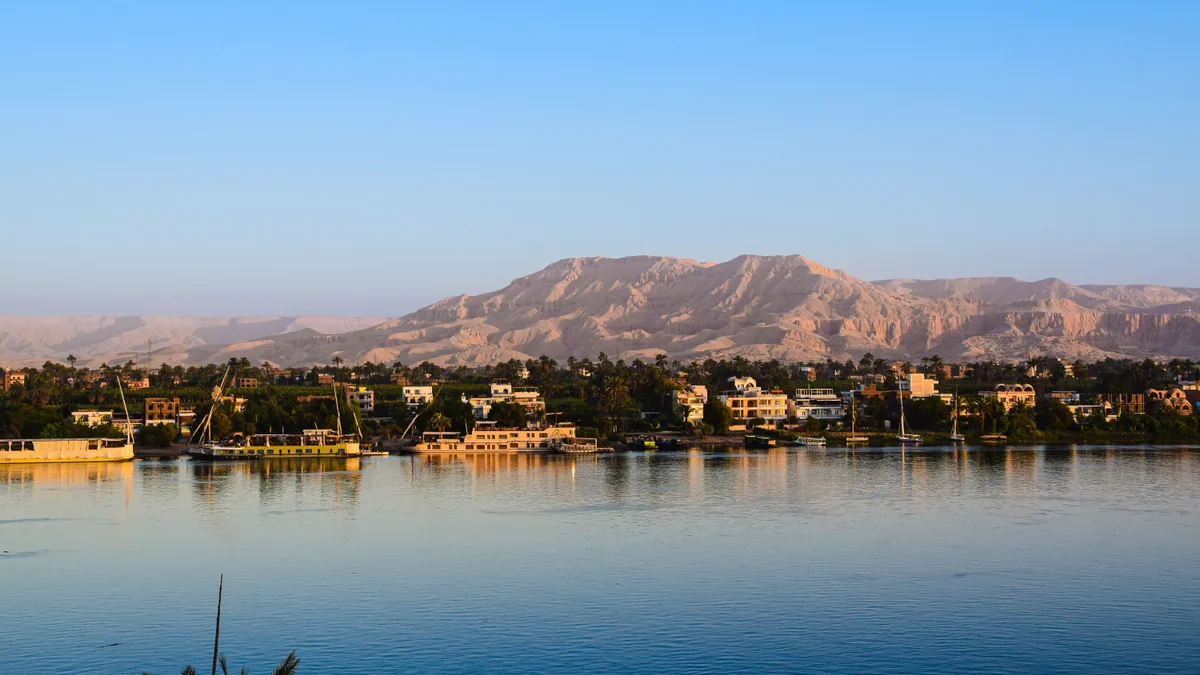
Both cities have good 4G in the centre, on the East Bank hotels strip and across the West Bank. Coverage follows the river closely, so a Nile cruise between Luxor and Aswan keeps a usable signal for most of the sailing, weakening on the long empty stretches around Edfu and Kom Ombo and behind the Esna lock.
Inside tombs, an eSIM Egypt plan gives you nothing. The Valley of the Kings, the interior of Abu Simbel and the deeper chambers at Dendera are all dead zones. Download your maps and audio guides in advance.
Red Sea resorts and Sinai
Hurghada, El Gouna, Sahl Hasheesh, Marsa Alam, Sharm el-Sheikh and Dahab all have reliable urban coverage. Signal drops off quickly once a dive boat is a few kilometres offshore, and the mountain roads through central Sinai — including the drive up to St Catherine’s Monastery — have long gaps.
Nuweiba and Taba on the Gulf of Aqaba are covered, though phones there sometimes latch onto a Saudi or Jordanian network across the water. Check the operator name before you start streaming, because that would be roaming outside your plan’s country.
Deserts, oases and the far south
This is where Egypt travel data genuinely runs out. The Western Desert route through Bahariya, Farafra and the White Desert has patchy service between settlements and none at all in the dune fields. Siwa Oasis has coverage in town and very little beyond it. The road south from Aswan to Abu Simbel crosses long stretches with no signal.
If you are heading into any of these, treat connectivity as unavailable and plan accordingly — offline maps, a copy of your booking references, and a rough time you have told someone you will check in.
Download the whole of Egypt in Google Maps offline before you leave your hotel wifi. The file is modest, it covers every site you are likely to visit, and it works in the tombs, in the desert and in the dead zones between Nile towns where paid mobile data in Egypt cannot help you.
How much Egypt travel data do you actually need
Most travellers overbuy Egypt travel data. Hotels, Nile cruise boats, cafés in Zamalek and beach clubs in El Gouna all have wifi of some description, and a good portion of your day is spent inside temples where you are not on your phone anyway.
Rough Egypt travel data guidance for a solo traveller:
- Light use — maps, WhatsApp text, boarding passes, occasional browsing: around 500 MB to 1 GB per week.
- Normal use — the above plus social media, ride-hailing, photo uploads, a few short video calls: roughly 3–5 GB for a ten-day trip.
- Heavy use — hotspotting a laptop, working remotely, streaming, uploading video: 10 GB and up for two weeks.
Two things push Egypt travel data usage higher here specifically. Uber and Careem both operate in Cairo and Alexandria and are the easiest way to avoid taxi negotiations, but ride-hailing keeps GPS and data running for the whole journey. And if you are sharing a connection with a partner via personal hotspot, double your estimate rather than adding a little.
If you are travelling as a couple or family, one person hotspotting a larger plan is usually simpler than four small ones — though it does mean everyone’s connectivity depends on one battery.

Sinai, the Western Desert and the Red Sea: planning the offline days
Egyptian coverage is concentrated where Egyptians live, which is a narrow strip along the Nile and the coasts. Everything else is genuinely empty, and an eSIM Egypt plan does not change that.
The Western Desert. Bahariya, Farafra, Dakhla, Kharga and Siwa all have signal in the towns. The desert between them — the White Desert, the Great Sand Sea, the long roads connecting the oases — has none. A White Desert overnight camp is offline by definition, and the drive out to it is several hours with nothing. This is the one part of an Egyptian itinerary where you should treat connectivity as unavailable and plan accordingly.
The Sinai interior. Sharm el-Sheikh, Dahab, Nuweiba and Taba are covered. St Catherine’s town has service; the Mount Sinai ascent and the high Sinai trekking routes do not. Near Nuweiba and Taba phones sometimes register on Jordanian or Israeli networks across the Gulf of Aqaba, which on a country-specific profile means no data at all until you move or select the network manually.
The Nile between the cities. Coverage follows the river closely, so a cruise between Luxor and Aswan holds a signal near the towns and the locks and thins in the agricultural stretches between. Kom Ombo, Edfu and Esna are fine. Do not plan a work call for the sailing hours.
Underground, there is nothing. The Valley of the Kings tombs, the interior of the Great Pyramid, Abu Simbel’s inner chambers and the Serapeum at Saqqara have no signal, which is unsurprising and worth mentioning only because people arrange to meet inside them.
The Red Sea boats. Liveaboard diving trips out to the Brothers, Daedalus and Elphinstone are offline for days at a time. Coastal day boats from Hurghada and Marsa Alam generally hold a connection.
What to do about it. Download the whole of Egypt offline in your mapping app before leaving your hotel Wi-Fi — the country is small enough that this is practical. Screenshot your hotel confirmations and driver arrangements. Agree a meeting point and time with a guide rather than relying on being reachable, because Egypt travel data is excellent right up until it is entirely absent.
Get your Egypt eSIMStay connected throughout Egypt — instant activation, no roaming bill.
Find an eSIM for Egypt and skip the roaming bill.
eSIM Egypt options compared with a local tourist SIM
Here is how the alternatives to an eSIM in Egypt stack up for a two-week trip.
| Option | Setup time | Passport registration | Keeps your home number | Coverage | Best for |
|---|---|---|---|---|---|
| Travel eSIM | 5–10 minutes, before you fly | No | Yes, as a second line | National 4G via local networks | Most travellers; data-only needs |
| Egypt tourist SIM | 20–45 minutes at a kiosk on arrival | Yes, passport required | No, unless you dual-SIM | Best-in-class on the chosen network | Long stays; needing an Egyptian number |
| Home carrier roaming | None | No | Yes | Same networks, higher cost | Very short trips with a bundled roaming pass |
| Pocket wifi rental | Order ahead, collect and return | Varies | Yes | Same networks | Groups sharing one connection |
| Hotel and café wifi only | None | No | Yes | Indoors only, variable speed | Budget travellers staying put |
The alternative to an eSIM Egypt plan deserves a fair hearing rather than a dismissal.
Pros of an Egypt tourist SIM
- You get an Egyptian mobile number, which some hotel bookings, delivery apps and domestic services ask for.
- Large data bundles are cheap in local terms, especially bought at an in-town Vodafone or Orange shop rather than the airport.
- For stays of a month or more, it is almost certainly the lower-cost choice.
Cons
- Registration is mandatory under Egyptian telecoms rules, so you hand over your passport and wait.
- Airport kiosks charge a tourist premium and may be closed or unstaffed on late-night arrivals at Cairo Terminal 3.
- You are offline between landing and reaching the counter — which is exactly when you want to call your driver.
- Swapping your physical SIM out risks losing it, and top-up menus are often in Arabic.
If you want the number and the price, buy the local SIM in town on day two rather than in the arrivals hall. If you want data working before you clear passport control, install an eSIM. Doing both is perfectly reasonable and costs very little extra.
For a group all needing the same connection, it is worth reading how a travel eSIM stacks up against a rented pocket wifi device before you commit to carrying a second gadget and its charger.
Setting up your travel eSIM Egypt line before departure
Install the eSIM Egypt profile before you fly. The activation step needs an internet connection, and airport wifi at Cairo, Hurghada and Sharm el-Sheikh ranges from serviceable to non-existent.
- Buy your plan and receive a QR code (Quick Response code) by email, usually within a few minutes.
- Connect to wifi at home. On iPhone, open Settings → Mobile Service → Add eSIM → Use QR Code. On most Android phones, go to Settings → Network & internet → SIMs → Add eSIM.
- Scan the code and let the profile download. Label it something obvious like "Egypt" so you can find it later.
- Leave the plan switched off until you land, unless it starts on activation — check the terms of the specific plan.
- On arrival in Egypt, turn on the Egypt line, set it as your Mobile Data line, and leave your home line active for calls and texts but with Data Roaming switched off for that line.
- Check that data roaming is switched on for the Egypt line. This trips up more people than anything else — a travel eSIM technically roams onto Egyptian networks, so it needs that toggle enabled.
If nothing connects after ten minutes, toggle flight mode, then restart the phone. Our step-by-step eSIM installation walkthrough covers the exact menus on each platform, and there is a separate guide to fixing an eSIM that will not connect if the network name never appears.
Pre-departure checklist:
- Confirm your handset model supports eSIM and is not carrier-locked
- Install the eSIM profile at home, on wifi
- Download offline maps for Cairo, Luxor, Aswan and your resort area
- Save your accommodation addresses in Arabic script for drivers
- Note your embassy’s contact details and check the current UK government travel advice for Egypt
- Screenshot your eSIM QR code and store it somewhere accessible offline
Calling apps and VoIP on an eSIM in Egypt
This is the Egypt-specific catch that no travel eSIM Egypt provider controls. Voice and video calling over the internet — WhatsApp calls, FaceTime, Messenger calls, Skype — has historically been restricted on Egyptian mobile networks. Text messages, voice notes, photos and file sharing all work normally. It is the live calling function that is affected.
The behaviour is not uniform. Some travellers report calls connecting fine, others find them failing or dropping after a few seconds, and results differ between networks and over time. Hotel wifi is often unaffected.
Practically: assume WhatsApp calls may not work over mobile data in Egypt, and plan around it. Voice notes are a reliable substitute. Many travellers and residents use a VPN, which is legal to use in Egypt though its effectiveness varies. Your WhatsApp account itself stays tied to your home number regardless of which SIM you are using — worth understanding if you are keeping your WhatsApp number while travelling on an eSIM.
For anything genuinely important, a conventional phone call from your home line will connect, at your carrier’s international roaming rate.
eSIM Egypt: frequently asked questions
Do I need an Egyptian phone number as a tourist?
Rarely. Hotels, tour operators and airlines will contact you by email or WhatsApp, and ride-hailing apps work with your existing registered number. The main cases for a local number are stays over a month, renting an apartment, or signing up for domestic delivery services.
Will an eSIM work on a Nile cruise between Luxor and Aswan?
Mostly, yes. Coverage follows the river and you will have a signal near the towns and moorings, with gaps on the long open stretches and around the Esna lock. Ship wifi is usually satellite-based, slow and shared, so your own data is generally the better option when there is a signal.
Can I use an eSIM at the Pyramids and in the Valley of the Kings?
The Giza plateau has good outdoor 4G coverage, though it slows when crowded. Inside the tombs at the Valley of the Kings, and inside the pyramids themselves, there is no signal at all. Download anything you need beforehand.
Is a travel eSIM cheaper than roaming with my home carrier?
For most travellers, comfortably so — Egypt sits outside almost every "roam like at home" zone, so standard roaming rates apply. If your carrier bundles a daily travel pass, compare the per-day cost against a data-only plan for the same duration. A short roaming versus eSIM cost comparison shows how the arithmetic usually falls.
Does an eSIM work in Sinai and the Western Desert?
In the towns, yes: Sharm el-Sheikh, Dahab, Nuweiba and Siwa town all have coverage. Between them, expect long dead zones on mountain roads and in the dunes. Treat any desert excursion as an offline trip.

The eSIM Egypt provider landscape, honestly
We name the alternatives and describe how each works; prices are deliberately omitted because Egyptian pricing and the exchange rate both move quickly.
The large marketplaces. Airalo and Nomad resell wholesale roaming capacity worldwide. Breadth is the appeal — Egypt plus Jordan and the Gulf in one app — and the trade-off is limited visibility of whether you land on Vodafone Egypt, Orange, Etisalat Misr or WE.
The unlimited-data specialists. Holafly sells daily unlimited plans. Read the fair-use terms: unlimited means full speed to a daily threshold then throttling, and tethering is often restricted.
The carrier-backed options. Ubigi runs on Transatel, owned by NTT Docomo, and Saily comes from the Nord Security group. Both are clearer about the underlying network and both allow in-app top-ups.
The Egyptian operators. Vodafone Egypt has the largest subscriber base and broad coverage; Orange and Etisalat Misr are close; WE, the state operator, is the newest network. All sell tourist bundles at Cairo, Hurghada and Sharm airports and in city stores, and per gigabyte they are cheaper than any travel plan. Two costs come with them: passport registration, and a connection that sits inside whatever VoIP restrictions the local networks apply.
The VoIP point is the real differentiator. Internet calling over Egyptian mobile networks is unreliable — WhatsApp and FaceTime voice and video frequently fail to connect, inconsistently and without explanation. Travellers on roaming profiles sometimes report better results than those on local SIMs, because the traffic is routed differently, but nobody should promise you this. If calls matter, test on arrival and have a fallback: hotel Wi-Fi often works where mobile data does not, and a conventional phone call always works.
What actually separates them. Ask about tethering, about top-ups, and about whether the provider says anything specific regarding VoIP in Egypt. Price per gigabyte is the least interesting variable here.
Competitor details last checked: September 2026.
Will WhatsApp calls work on an eSIM Egypt plan?
Sometimes, and not predictably. Voice and video calling over the internet is restricted on Egyptian mobile networks in ways that vary by network, location and time. Messaging, photos and voice notes work normally throughout. Travellers on roaming profiles often have better luck than those on local SIMs, but treat that as a tendency rather than a feature. Hotel Wi-Fi is the reliable fallback.
Do I need to register my passport for an eSIM in Egypt?
No. Registration applies to SIM cards issued by Egyptian operators. A travel profile connects as an inbound roamer under an agreement your provider already holds, so there is no counter and no paperwork.
How much Egypt travel data does two weeks actually use?
Three to six gigabytes for a typical Cairo, Luxor and Aswan itinerary. Uber and Careem in Cairo are the main draw, followed by photograph upload. Hotels, cruise boats and cafés all have Wi-Fi, which keeps the total down. A desert or Sinai section adds nothing at all, because there is no signal to use.
Which network should an eSIM Egypt plan connect to?
Vodafone Egypt and Orange have the widest footprints and are the safest defaults. Etisalat Misr is competitive in the cities and along the coasts. WE is newest and thinnest outside the main corridors. For a Nile-and-Cairo itinerary any of them works.
Three companion pages. Our comparison of the best eSIM plans for Egypt is the one to read if you are still choosing a provider; the multi-country Africa guide covers an itinerary crossing more than one border; and the South Africa guide is the other end of the continent, with a very different network picture.
Get connected in Egypt from the moment you land.
Before you go
Three things make the difference between a smooth arrival and a frustrating one. Install and test your eSIM profile at home rather than in the arrivals hall. Download Egypt’s offline maps and screenshot your key addresses, because the country’s best sights are also its worst dead zones. And decide in advance whether you need an Egyptian number at all — most two-week visitors do not.
If you want data live before you reach passport control at Cairo, Hurghada or Sharm el-Sheikh, Atlas eSIM covers Egypt with plans sized from a few days to a month, so you can match the allowance to the trip rather than the other way round.
Browse Atlas eSIM plans for Egypt and get set up today.