
Switzerland is one of the easiest countries in Europe to work remotely from, and the reason is boring in the best possible way: the infrastructure simply works. Fixed-line and mobile networks are among the fastest and most consistently available in the world, mountain valleys included, and the Central European Time zone puts you in comfortable overlap with London, Dubai and the US East Coast. The real friction for a Switzerland digital nomad is not connectivity — it is cost, and the visa rules that decide how long you can stay.
This guide covers what you actually need to plan: which mobile networks reach where, how much data a working week consumes, where to find coworking in the main cities, and what your options are for getting a Swiss number or Swiss data.
Quick answer: Switzerland has excellent 4G and 5G coverage from three national carriers (Swisscom, Sunrise and Salt), with typical mobile download speeds well into the tens of megabits per second in cities and usable service in most Alpine valleys. For a stay of a few days to a few weeks, a travel eSIM — an embedded SIM you install as a digital profile rather than a plastic card — is the least effort; for several months, a Swiss prepaid SIM with a local number starts to make more sense.
Internet reliability and Switzerland internet speed
Switzerland consistently ranks near the top of global fixed broadband league tables, and the mobile picture is similar. All three national mobile operators run extensive 5G, and 4G is essentially ubiquitous in populated areas.
- Swisscom — the former state incumbent, generally the deepest rural and Alpine coverage, and the network most likely to have signal at altitude.
- Sunrise — strong nationwide coverage, competitive in cities and along transport corridors.
- Salt — good urban and suburban coverage, thinner in the most remote valleys.
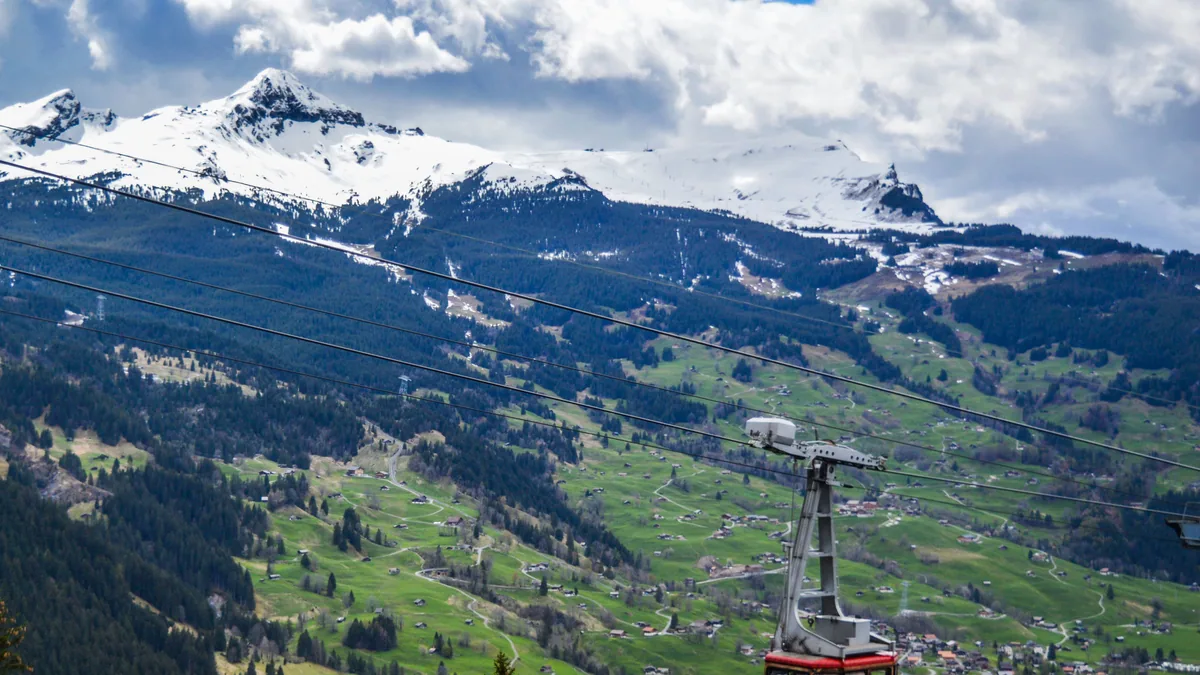
In practice this means a video call from a café in Zurich, Basel or Lausanne is uneventful. On a train between Bern and Geneva you will hold a call for most of the journey, with dropouts in tunnels — and Switzerland has a lot of tunnels. In an Alpine village like Zermatt or Grindelwald you will usually have workable 4G, but the mountain behind you decides everything, and a hotel in a narrow valley can be a dead spot 200 metres from full bars.
Fixed Wi-Fi (wireless network) in Swiss accommodation is reliable and usually fast. Hotels rarely charge for it. Airbnb hosts commonly have fibre. Public Wi-Fi at Zurich Airport (ZRH), Geneva Airport (GVA) and Basel (BSL/EAP) is free and works, though airport networks are the last place you want to log into a work system without a VPN (virtual private network).
Swiss trains are a genuinely good mobile office — wide tables in first class, power sockets, and a network that mostly keeps up. What breaks calls is tunnels, not coverage. Schedule anything important for the flat stretches: Zurich–Bern and Lausanne–Geneva are far friendlier than the Gotthard route.
Where connectivity actually gets awkward
Three situations catch remote workers out. Underground: Swiss cities have limited metro networks, but Zurich’s tunnel sections and the Lausanne metro will interrupt calls. High altitude: cable cars and ski areas have patchy service between stations even when the summit has a mast. And cross-border zones: near Geneva, Basel and Chiasso your phone may latch onto a French, German or Italian network. If your data plan is Switzerland-only, that can mean an unexpected gap in service or, on a roaming contract, an unexpected charge.
A multi-country European plan avoids this entirely, which matters if you plan day trips to Annecy, Como or the Black Forest.
Time zones and the Swiss working day
Switzerland runs on Central European Time (UTC+1), shifting to Central European Summer Time (UTC+2) from late March to late October. That gives you:
| Your counterpart in | Overlap with a 09:00–18:00 Swiss day |
|---|---|
| London | Almost total — one hour behind |
| Dubai | Morning through early afternoon |
| New York | Mid-afternoon to end of day |
| San Francisco | Late afternoon only, roughly 17:00–18:00 |
| Singapore | Early morning only |
| Sydney | Barely — before 09:00 Swiss time |
For teams based in Europe or the UK, Switzerland is effectively a home time zone. For US East Coast work, a 10:00–19:00 Swiss day covers the American morning comfortably. West Coast work is the hard case: you are looking at evening calls, and Swiss evenings are quiet, so a 22:00 stand-up from a flat with thin walls is a social problem as well as a scheduling one.
Swiss working culture is punctual and boundaried. Meetings start on time, and colleagues genuinely stop working at the end of the day. Sunday is quiet by law and custom — most shops close, and that includes places to buy a SIM card.
Coworking Switzerland: cities and what they cost you
Coworking Switzerland is well developed but priced like everything else in the country. Expect day passes in the range you would pay for a decent restaurant lunch elsewhere in Europe, and monthly hot desks to sit meaningfully above the European average. Booking a week rather than a string of day passes usually improves the rate.
Zurich
The densest concentration of spaces and the strongest professional network. Kreis 4 and Kreis 5 (the former industrial districts around Zürich West) host most of the independent spaces, alongside international operators near the main station. Zurich suits you if you want events, meetups and access to the finance and tech scene. It is also the most expensive place in the country to sleep.
Geneva and Lausanne
Geneva is the international-organisation city — UN agencies, NGOs, diplomacy — and its coworking spaces skew towards consultants and small international teams. It is French-speaking, and the lakeside setting is hard to beat. Lausanne, 40 minutes along the lake, is younger and cheaper, with a startup ecosystem built around EPFL. Both put you within an hour of France.
Basel, Bern, Zug and Lugano
Basel is pharma, design and the German–French–Swiss border triangle. Bern is the capital, administrative and calm, with the lowest coworking prices of the big cities. Zug is the crypto and holding-company hub — small, wealthy and disproportionately well connected. Lugano gives you Italian-speaking Switzerland, palm trees and a short hop to Milan.
Pros of working remotely from Switzerland
- Infrastructure that rarely fails: fast fibre, strong mobile coverage, punctual trains
- Excellent time-zone position for European and US East Coast teams
- Compact geography — Zurich to Geneva in under three hours, mountains 90 minutes from any city
- Very high personal safety and clean, quiet public space
- English widely spoken in professional settings in Zurich, Geneva, Basel and Zug
Cons
- Cost of living is among the highest in the world; accommodation dominates your budget
- No dedicated digital nomad visa — you are working within tourist-entry rules unless you qualify another way
- Coworking and short-term flats book out during major events and ski season
- Sundays and public holidays shut down retail, including phone shops
- Four language regions mean signage and admin switch language as you travel
The visa reality
Switzerland is in the Schengen Area but not the EU, and it has no digital nomad visa. Most non-EU visitors can stay up to 90 days in any 180-day period, and Swiss days count towards your Schengen total. Working remotely for a foreign employer during a tourist stay sits in a grey area that many people occupy without incident, but it is not a residence permit, and it does not let you take on Swiss clients. Check the rules for your own nationality on the Swiss federal government’s official portal at admin.ch before you book anything long.
If a longer stay is the goal, look at the routes that actually exist: EU/EFTA freedom of movement, an employer-sponsored permit, or a study place.
Realistic data needs for a remote work trip
Guessing your data allowance is how people end up either overpaying or throttled mid-call. Work from what you actually do.
Rough consumption per hour:
- Video call, camera on, standard definition: 500 MB – 1 GB
- Video call, audio only: around 50 MB
- Cloud file sync and email: 100–300 MB during an active working day
- Maps, messaging, browsing: 100–200 MB
- Music streaming: around 100 MB
- Video streaming in HD: 1.5–3 GB
For a five-day working week where hotel or coworking Wi-Fi handles the heavy lifting and mobile data covers commutes, cafés and the occasional tethered emergency, most people land between 3 GB and 8 GB. If you are tethering a laptop as your primary connection — working from a train, or from a village where the flat’s Wi-Fi turned out to be useless — plan on 1–2 GB per working day.
A practical way to size it:
- Count your working days.
- Multiply by 500 MB if you have reliable Wi-Fi most of the time, or by 1.5 GB if you expect to tether regularly.
- Add 3 GB for maps, calls home and weekend use.
- Round up to the next plan size. Running out mid-trip costs more than the next tier up.
If you are unsure, an unlimited or high-allowance plan for a short trip removes the decision entirely. For a month or more, watch how much you actually use in week one and adjust.
Getting connected: eSIM, local SIM or roaming
Switzerland is not in the EU, so the EU’s "roam like at home" rules do not automatically apply. Some European carriers include Switzerland in their roaming zones and some pointedly do not — check your contract’s fine print rather than assuming, because Swiss roaming is a classic source of nasty bills. Our eSIM versus roaming cost comparison walks through how the maths usually falls out.
Here is how the realistic options compare for a working traveller:
| Option | Setup time | Where you do it | Swiss number? | Best for |
|---|---|---|---|---|
| Travel eSIM | 5–10 minutes | At home, before departure | No | Trips of a few days to a few weeks; multi-country itineraries |
| Swiss prepaid SIM (Swisscom, Sunrise, Salt) | 30–60 minutes | Airport shop, carrier store, or Swiss Post | Yes | Stays of a month or more; needing a local number |
| Home carrier roaming add-on | Minutes | Your carrier’s app | No | Short stays where your plan explicitly includes Switzerland |
| Wi-Fi only | None | Nowhere | No | One-night stopovers; genuinely fixed-desk stays |
| Portable Wi-Fi hotspot rental | Collection and return | Airport counters, limited availability | No | Teams sharing one connection |
Swiss prepaid SIMs are legitimate and easy enough to buy — airport shops at Zurich and Geneva, carrier stores in any city centre, and Swiss Post branches all sell them. You will need your passport, because registration is mandatory. The catches are that they are Switzerland-focused (crossing to France or Italy means roaming again), shops close on Sundays and early on Saturdays, and prepaid data in Switzerland is not cheap.
A travel eSIM avoids the queue and the passport photocopy. Because it installs as a digital profile, you set it up at home over your own Wi-Fi and it activates when you connect to a Swiss network after landing. Your physical SIM stays in the phone, so your home number keeps receiving calls and two-factor authentication codes — which matters a great deal if your bank texts you a code every time you log in. Atlas eSIM covers Switzerland with both single-country and regional Europe plans, and the regional option is the one to look at if your trip includes neighbours.
The trade-off is honest: an eSIM does not give you a Swiss mobile number. If you need one — for a Swiss bank, a local rental agreement, or a delivery service that will not accept a foreign number — get a local prepaid SIM, or run both.
When a Swiss eSIM is not the right answer
- Your phone does not support eSIM. Most flagship phones from 2018 onward do, but budget models and some region-specific variants do not. Check your exact model against our list of phones that support eSIM before you buy anything.
- You are transiting. A four-hour layover at Zurich Airport does not justify a data plan. Airport Wi-Fi is fine.
- You are staying six months. At that point a Swiss contract or long-term prepaid plan, with a local number and local pricing, wins.
- Your employer supplies a work phone with global roaming. Use it, and keep the receipts. Our guide to expense-ready data for Swiss business trips covers the documentation side.
Setting up before departure versus on arrival
Do it before you leave. The install needs Wi-Fi and a couple of quiet minutes, and doing it in your own kitchen beats doing it at baggage reclaim.
- Confirm your phone is eSIM-capable and network-unlocked.
- Buy and install the eSIM profile while on home Wi-Fi — the step-by-step eSIM installation guide covers both iOS and Android menu paths.
- Label the profile something obvious, such as "Switzerland work".
- Leave the profile switched off until you land.
- On arrival, enable it, set it as your mobile data line, and turn data roaming on for that line — this sounds wrong but is required, because the eSIM connects to a Swiss partner network rather than its own.
- Keep your home SIM active for calls and texts, with its data switched off.
If nothing connects within a few minutes, toggle flight mode, then select a network manually — Swisscom or Sunrise are the safe picks. Our eSIM troubleshooting checklist covers the rest.
Pre-departure checklist
- [ ] Confirm eSIM support and carrier unlock on your specific phone model
- [ ] Install and label the data profile at home
- [ ] Estimate your data need using working days, not trip days
- [ ] Book coworking for your first week, especially in Zurich and Zug
- [ ] Check whether your accommodation’s Wi-Fi speed is stated, and ask if it is not
- [ ] Download offline maps for any Alpine areas you plan to work from
- [ ] Check your Schengen day count if you have travelled in Europe recently
- [ ] Pack a Type J plug adapter — Switzerland’s sockets differ from the rest of Europe
- [ ] Set up a VPN for airport and café networks
FAQ
Is the internet fast enough in Switzerland for video calls?
Yes, comfortably. Fixed broadband in Swiss accommodation is typically fibre, and mobile 4G and 5G speeds in cities and towns handle multi-person video calls without difficulty. The exceptions are deep Alpine valleys and rail tunnels.
Do I need a Swiss SIM card to work remotely from Switzerland?
Only if you need a Swiss phone number. For data alone, a travel eSIM or a roaming add-on that explicitly includes Switzerland does the job, and neither requires a shop visit or passport registration.
Does Switzerland have a digital nomad visa?
No. Switzerland has no dedicated remote-work visa, and most visitors work within the standard 90-days-in-180 Schengen entry allowance. Longer stays require an employment, study or EU/EFTA route, so check your nationality’s requirements on the federal government portal.
How much mobile data should I budget for a two-week working trip?
Most people managing on Wi-Fi with mobile data as backup use 5–10 GB over two weeks. If you expect to tether a laptop for several hours a day, plan on 20 GB or more, or choose a high-allowance plan.
Will my Swiss data plan work in nearby France, Germany or Italy?
Not necessarily. Switzerland-only plans stop at the border, and border cities like Geneva and Basel can even connect you to a foreign network by accident. If you are planning day trips, pick a regional Europe plan that lists Switzerland alongside its neighbours.
Before you go
Book your first week of coworking before you arrive — Zurich and Zug spaces fill up, and having a confirmed desk removes the worst of the first-day scramble.
Sort out accommodation Wi-Fi expectations in writing. Swiss connections are usually excellent, but "fast Wi-Fi" in a listing is not a number, and a mountain chalet is where the exceptions live.
Then set up your data before you fly rather than after you land. Atlas eSIM covers Switzerland on single-country plans and on regional Europe plans if your itinerary crosses a border — and if you want the connectivity detail on its own, the Switzerland eSIM travel guide goes deeper. Planning a comparable stay elsewhere in Europe? The Netherlands remote work guide covers a very different cost profile with similar infrastructure.